

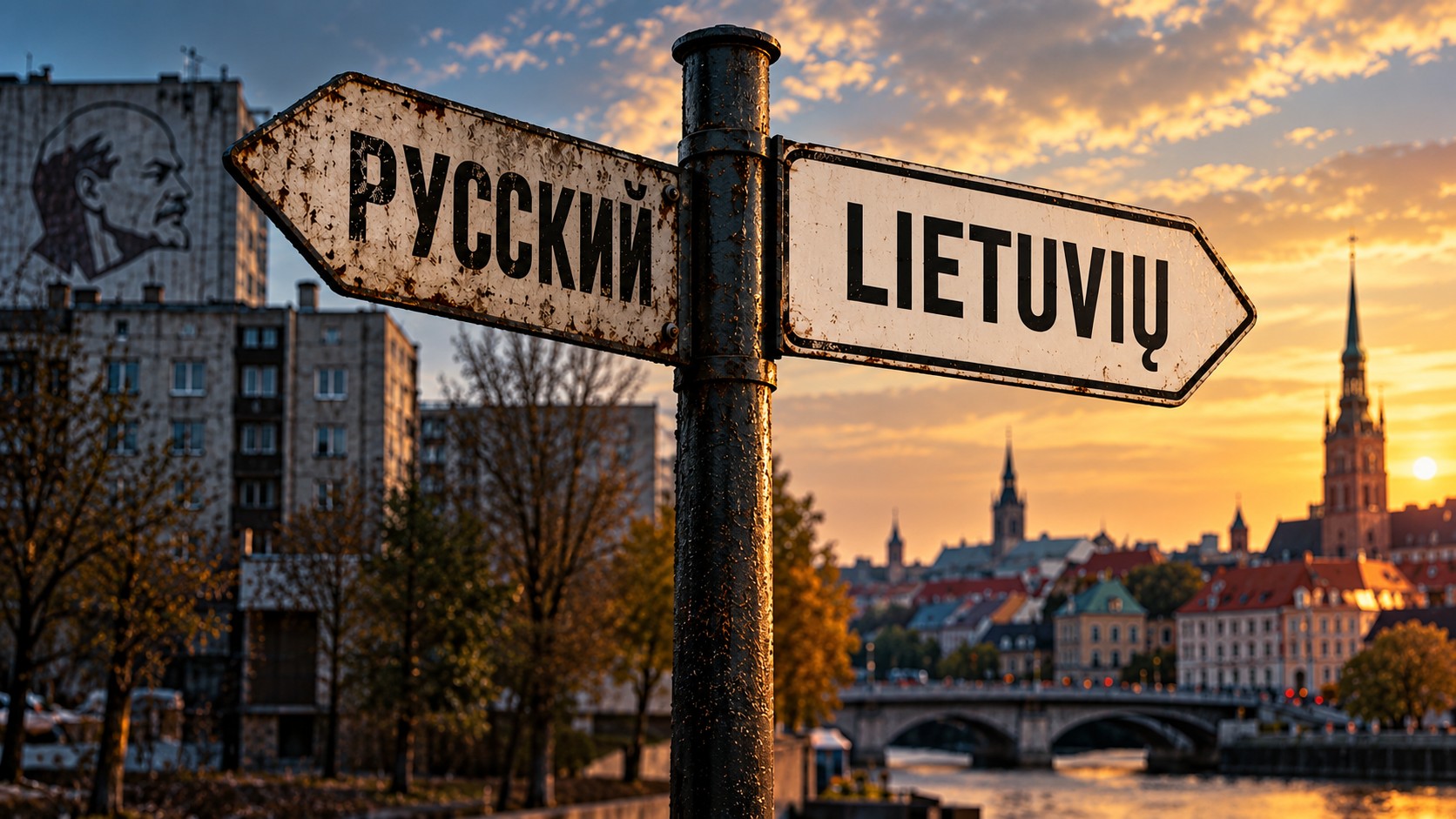
I want to share a few thoughts about the Russian language, because in Lithuania this is one of those subjects that can trigger a surprisingly emotional reaction almost immediately. Let me say at the outset what this text is not: it is not an argument for banning Russian, and it is not an argument that “a language is just a language, so none of this matters.” Reality, at least as I have experienced it, is much more complicated than either of those positions. The easiest way for me to explain why is through three stories from my own life.
The first story
In the summer of 2023, as I do almost every year, I was spending my holiday in Lithuania. By then the country had already taken in many people fleeing Russia’s full-scale war against Ukraine, and a significant number of those refugees spoke Russian. That in itself did not bother me, but I was surprised by the decision to temporarily relax Lithuanian-language requirements for war refugees in certain areas of employment. My friends and I discussed it quite a lot, and there were reasonable arguments on both sides.
The humanitarian argument is obvious. A person has fled a war, arrived in a foreign country and immediately needs work, income and somewhere to live. It would be absurd to meet someone at the border with a Lithuanian-language examination and say: until you pass this, your life cannot begin. But there is another side to it as well. Many younger Lithuanians simply do not speak Russian anymore, and I do not regard that as a tragedy. In my view, a person entering a shop, hospital or public institution in Lithuania should be able to receive a service in Lithuanian, the country’s state language.
That is where the first dilemma begins. On the one hand, Lithuania talks a great deal about resilience to the Russian information and cultural space, for understandable historical and security reasons. On the other hand, for equally understandable practical reasons, we create more and more situations in which Russian once again becomes the easiest common language. “Only temporarily,” “only for now,” “until people learn Lithuanian” all sound perfectly reasonable. The difficulty is that temporary arrangements have a curious habit of becoming permanent.
Then, during that same holiday, I became ill. Not with an ordinary cold: I developed a strange skin rash and needed a dermatologist. Anyone familiar with the Lithuanian healthcare system can probably guess the next part. Seeing a specialist the very next day is not normally as simple as snapping your fingers, and going private does not always solve the problem either.
I was not in Vilnius or Kaunas, but in the Joniškis area in northern Lithuania, so my problem was very practical: where exactly was I supposed to find a dermatologist at short notice? A local pharmacist suggested that I drive to the hospital in Akmenė and try the emergency department. I did. They told me that a dermatologist was available and that I could be seen after a short wait.
This essay is not about the Lithuanian healthcare system, so I will spare you the waiting-room details. In fact, I did not have to wait very long. The initial examination was carried out in Russian by two Russian-speaking medical workers, with a Lithuanian-speaking staff member helping with translation. At first glance, there was nothing particularly dramatic about that.
But the story became more interesting when I reached the specialist. The dermatologist was also Russian-speaking. There were two doctors in the room, and the specialist spoke Lithuanian with difficulty and a strong accent. From time to time she could not find a word and the other doctor helped her. I quickly realised that speaking Russian would be much easier for her, so I told her that she could speak Russian with me because I understand it fluently.
And here is the detail that stayed with me: she did not switch to Russian. She continued speaking Lithuanian even though she knew that the two of us could communicate faster, more easily and probably more precisely in Russian. I had personally offered her that easier option, and I was a patient to whom Russian posed no problem at all. Yet she still made the effort to provide the medical service in Lithuania’s state language.
In the end I received, in my judgement, perfectly normal and competent medical care and a prescription for the medication I needed. The bureaucracy worked slightly less smoothly because I am not a permanent resident of Lithuania, so there was some discussion in the accounts office about how the visit should be paid for. Eventually I paid €25 and went on my way. What stayed with me was a much harder question: what exactly am I supposed to say about a doctor whose Lithuanian is not yet perfect, but who insists on using it even when the patient himself offers to switch to Russian?
I could not bring myself to say that such a specialist should not be allowed to work in Lithuania. She is learning the language and making an effort, while also possessing professional knowledge that I happened to need very much at that moment. Without her, perhaps I would have waited another week or two for a dermatologist. So what matters more in a situation like this: perfect Lithuanian, a genuine effort to use Lithuanian, or professional competence? I do not have a neat answer. That is precisely why I call it a dilemma.
The second story
Now let us go back to the first years after Lithuania restored its independence from the Soviet Union in 1990, roughly the period from 1992 to 1997. I was a student at the Higher Technical School in Klaipėda, studying in a programme that no longer exists, roughly equivalent to a junior engineering qualification in vehicle repair and maintenance. I had grown up in the Soviet period, and Russian was almost as natural to me as Lithuanian. That was simply the reality of my generation: some learned Russian better than others, and I happened to learn it very well.
My English was not bad either, certainly better than that of many people my age at the time, but it was nowhere near as strong as my Russian. Here is the part that may be difficult for younger readers to imagine today: there simply were not enough technical textbooks and reference works in Lithuanian. I am not talking about general books “about cars.” I mean the kind of precise engineering information you actually need when studying mechanics and vehicle technology.
We needed tables for fits and tolerances, shaft and hole deviations, engineering mechanics calculations, forces, moments, stresses, coefficients, formulas and technical reference data. That meant textbooks, standards and specialist handbooks, and a large part of that material was available in Russian. Our lecturers did an enormous amount of work. They did not merely stand in front of the class and repeat what a textbook said; they translated, explained concepts in Lithuanian and developed or used Lithuanian technical terminology while working from Russian-language material.
The lectures themselves were in Lithuanian and we studied in Lithuanian, but when you opened a reference book, very often it was Russian. Need an allowable deviation? Russian. Need a table for a shaft-and-hole fit, or data for a mechanics calculation? Russian again. In a very literal sense, our lecturers had to build a bridge between an education being delivered in Lithuanian and a technical knowledge base that was still largely inherited from the Soviet system.
There was another detail that may seem unusual today. Engineers now constantly encounter ISO standards and think of them as the obvious international frame of reference. In the books we used, however, the reference system was very often GOST, the Soviet system of state standards. Much of the technical environment in which we studied was still built around GOST rather than the Western ISO framework. A lecturer could not simply walk into a bookshop and ask for the same specialist handbook in Lithuanian and updated to ISO. In many fields such a book simply did not exist.
That was our reality: old technical literature in Russian, standards based on GOST, while the country, its institutions and its education system were already Lithuanian and increasingly oriented towards the West. In the middle were students like us, who somehow still had to be trained properly. And we were. We completed our studies, received our diplomas and became mechanics, technicians and engineers.
So what should I do with that history now—pretend those books never existed? Pretend that the knowledge I gained from them was somehow less valuable because the text happened to be in Russian? Of course not. And that leads to the second dilemma. A language can be an instrument of occupation, propaganda and cultural influence, but exactly the same language can also be a table of engineering tolerances. A table of fits has no political opinions, and a mechanics formula does not care which language was used to explain it.
The underlying problem has not disappeared even today; English has simply replaced Russian in many specialist fields. Lithuanian is of course used in universities and vocational education, but the deeper you go into a narrow scientific or technical niche, the sooner you encounter the limits of a small language community. Lithuania cannot physically translate every specialist book, manual, standard or scientific paper published in the world. Today we often read manufacturers’ documentation, programming references and research articles in English; when I was young, Russian occupied a large part of that same space.
That raises a different question altogether. Do we protect Lithuanian by isolating it from other languages, or do we strengthen it when a person can function fully in Lithuanian while also opening an English, German, Polish or Russian technical source and bringing useful knowledge back from it? Knowing Russian has never made me any less Lithuanian. If anything, it has given me access to an additional source of information.
The third story
This summer, while driving from Lithuania towards the Czech Republic, we stopped first in Warsaw. We ordered a Bolt and the driver turned out to be a young Tajik man, around twenty-one years old, barely older than my son. He spoke Russian and listened to quite a lot of Russian-language music, so we ended up chatting. He told me that his older brother had also lived in Poland but did not like it there.
Why? According to him, Polish people did not want to speak Russian with his brother, which made everyday life difficult. So the brother moved to another country. Guess where. Yes—Lithuania.
Something clicked in my head at that moment. Lithuania is still a remarkably convenient country for someone who speaks Russian. You hear the language among medical staff, Bolt drivers, truck and bus drivers, construction workers and employees in many service industries. And one distinction matters here: when I say “Russian-speaking,” I do not automatically mean “Russian.”
A Russian-speaker may be Ukrainian, Belarusian, Tajik, Kazakh, Moldovan or from somewhere else entirely. A person may be deeply hostile to the present Russian government and still use Russian every day as a first or common language. Those are different things, although public debate often mixes them together. Our next Bolt driver in Warsaw was, incidentally, another Tajik man, and once again we spoke Russian. That was only one day in Poland; we still had a week in the Czech Republic ahead of us.
Prague and Karlovy Vary
Prague is a beautiful city and, for someone who has lived in Denmark for many years, it has an unexpected Danish connection: the famous Danish astronomer Tycho Brahe is buried there. But what surprised me most was something else—the amount of Russian I heard. There were Russian-speaking tourists, Russian-speaking residents, and in some places menus, advertisements and signs in Russian. Even I, someone who speaks Russian fluently and certainly does not panic when I hear it, eventually found the sheer amount of it slightly irritating.
Then we travelled to Karlovy Vary, and there the effect was much stronger. After a few days you can almost start wondering whether you are really in the Czech Republic. In parts of the hotel it was easier to communicate in Russian than in English, shops displayed Russian-language signs, some staff were Russian-speaking and Russian was constantly audible in the streets. Karlovy Vary has a long history of attracting wealthy visitors from the former Soviet Union, so none of this appeared overnight.
Standing there, however, I found myself thinking seriously for the first time about what Lithuania might look like in ten or fifteen years. Not because I imagine Lithuania inevitably becoming some kind of “little Russia,” but because the mechanism can be much simpler than that. Languages do not spread only because somebody pushes them politically. They also spread because they are convenient.
If a newcomer can walk into a shop and be served in Russian, order a taxi and speak Russian, visit a doctor, find a job and handle a large part of everyday life in the same language, then a very simple question appears: what is the practical incentive to learn Lithuanian? I do not mean the ideological or moral incentive. I mean the practical one. To me, this is one of the most important points in the entire discussion.
And now, Denmark
Here I can add another very personal comparison. I have lived in Denmark for many years, and Danish is my everyday working language. Do I speak perfect Danish? Definitely not. I make mistakes, sometimes forget a word, and occasionally hear a dialect that makes me wonder for a second whether the person is even speaking the same language I learned.
But I live and work here independently. I can go to a bank and explain what I need, speak to the police, call the municipality, and deal with insurance, taxes or other everyday matters. My Danish may not be perfect, but if it is good enough for me to function independently in Danish society, perhaps it is good enough. I think it is. Nobody expects me to write like Hans Christian Andersen; I simply need to be able to live in a country whose language is Danish.
Now guess which language I use with my family doctor. Lithuanian. The explanation is very simple: our doctor is Lithuanian. Of course I speak Lithuanian with her, because when two Lithuanians are discussing symptoms, pain and medical nuances, Lithuanian allows us to express ourselves much more precisely. Does that mean I am not integrated into Denmark, that I disrespect Danish or refuse to learn it? I think that would be a rather absurd conclusion.
But this example also reveals the crucial difference. I can visit another doctor in Denmark and communicate in Danish. I can go to the bank, contact the police or deal with the municipality without searching for a Lithuanian speaker. Lithuanian in my doctor’s office is a convenience, not a necessity.
And this is where the Linas Slušnys case enters the story
In early October 2026 a public dispute arose in Lithuania involving child and adolescent psychiatrist Linas Slušnys and a Russian-speaking teenager he had seen. Slušnys said that he provided help in Lithuanian while child-rights specialists who were present interpreted, and he also publicly stated that he had consciously stopped speaking Russian “on principle.” What interests me here is not only the dispute itself, but the broader question of what it means, in a professional context, to say that someone does not use Russian or cannot communicate in it adequately.
Slušnys began his medical studies at the very end of the Soviet period and completed his paediatric qualification in 1996, later specialising in child and adolescent psychiatry. I do not want to pretend that I know which textbook he held in his hands in his third year or the language of every lecture he attended. I do not know that. But remembering my own studies in almost the same period, I would be very surprised to learn that somebody who began medical training while the Soviet system was still disappearing had barely encountered Russian in a professional context.
It is difficult for me to imagine. I studied engineering, and my tables of fits, GOST standards and mechanics reference books were in Russian. He studied medicine at a time when the Soviet medical system did not magically evaporate on the morning of 11 March 1990, the day Lithuania restored its independence. So when the public debate turns to whether Slušnys could speak Russian at a professional level at all, I find the question itself somewhat strange.
Of course, I cannot assess his present-day professional vocabulary in Russian. Perhaps he has not used certain medical terms for thirty years, and perhaps discussing diagnoses, symptoms and treatment in Lithuanian is genuinely much easier for him today. All of that is entirely possible. But he began his education at the end of the Soviet system, which makes a different question more interesting to me than “does he speak Russian well enough?” The question is: if a doctor does know the patient’s language, should a principle alone determine whether he uses it in a crisis?
This brings me back to my Lithuanian family doctor in Denmark. She speaks Danish, I speak Danish, and the two of us could spend half an hour very conscientiously speaking Danish to one another. But why would we, when we both speak Lithuanian fluently? If I came in with a simple cold, perhaps the difference would be small. But imagine a very different situation: a person is in a psychological crisis.
In psychiatry, understanding the sentence is not enough; the emotion, implication, choice of words and sometimes even the pause between two sentences can matter. That is why the argument “someone can translate” seems more complicated to me in psychiatry than, say, when explaining that a patient has a broken leg. On the other hand, there is part of Slušnys’s argument that I find difficult simply to dismiss: how does a child growing up in Lithuania reach the age of roughly sixteen without being able to communicate properly in Lithuanian? That is no longer a question for one doctor alone. It is a question for parents, schools, the state and the wider system.
If a person spends sixteen years in an environment where everyone around him switches to Russian, we should not be shocked when, in the seventeenth year, Lithuanian is still not really necessary for him. That is why I see two very different problems in this story, although they have often been merged into one. The first is why a child growing up in Lithuania does not know Lithuanian. The second is what a doctor should do here and now when a child in crisis is sitting in front of him and does not know the language.
On the first question, society can afford to be very principled. On the second, I am much less certain. The child sitting in front of the doctor today is not personally responsible for the linguistic environment that adults and institutions created around him during the previous sixteen years. His crisis will not wait for Lithuania to solve its language-policy problems. Perhaps that is why the entire debate about Russian is so uncomfortable: principles are usually very clear until they collide with an actual human being.
So what should Lithuania do with the Russian language?
I do not know. I genuinely do not. That is why I called this essay “The Dilemmas of the Russian Language,” not “What Lithuania Must Do About Russian.” I dislike both extremes: the view that Russian is almost inherently something bad, and the opposite view that “the language does not matter, as long as people understand each other.”
It seems absurd to me to equate the language itself with Putin, the Kremlin or tanks. Millions of people speak Russian because it is the language in which they grew up, and that fact alone tells us nothing about their political views. At the same time, I cannot fully accept the claim that it makes no difference to a state which language a person can use for decades without learning the state language. For an individual, perhaps the difference is small. For a state, it is not.
If I meet someone in the street and it is easier to explain something in Russian, I will speak Russian. I see no point in pretending that I do not know the language. If I need technical documentation and the only version I can understand is Russian, I will read it in Russian. If my doctor in Denmark is Lithuanian, I will speak Lithuanian with her. But at the same time I need enough Danish that I do not have to search for a Lithuanian every time life presents a problem.
To me, that is the essential distinction: having the option to use your own language is one thing; being unable to function in the state language is something entirely different. Lithuania can help a Ukrainian who has just fled war and does not yet know a single Lithuanian word, while still expecting that after several years that person will at least be able to communicate at a basic level in Lithuanian. I can speak Russian with a Tajik man and still not want Russian to become an automatic second service language in Lithuania. I can read a Russian technical handbook without valuing Lithuanian any less.
We can also have a Russian-speaking doctor whose Lithuanian is not yet perfect, but who makes a genuine effort and continues the consultation in Lithuanian even when the patient offers Russian. The problem, as I see it, does not begin when people speak Russian. It begins when speaking Lithuanian is no longer necessary. That is probably the boundary I personally would not want Lithuania to cross.
I do not want to police the languages people use with their families, friends or with me. I do not want to tell a Ukrainian, Belarusian or Tajik which language belongs in their private life. But I also would not want to wake up one day in a country where Lithuanian has become an optional accessory for newcomers because it is possible to live there for ten, fifteen or twenty years without it. There is no beautifully simple answer, because the very same Russian language helped me study engineering thirty years ago, allows me today to speak to people I might otherwise not be able to communicate with, and in some circumstances may help a doctor and patient understand one another better.
Yet that same convenient language, once enough people can use it, can quietly stop being an additional language and become an alternative to Lithuanian. And that leaves me with the question that runs through this entire essay: at what point is multilingualism an advantage for the individual, and at what point does a state create an environment in which knowing its own language is simply no longer necessary?
I do not know. What do you think?
For context on the publicly discussed Linas Slušnys case: LRT’s report. Biographical information about his medical studies and professional career is available in public biographical sources.